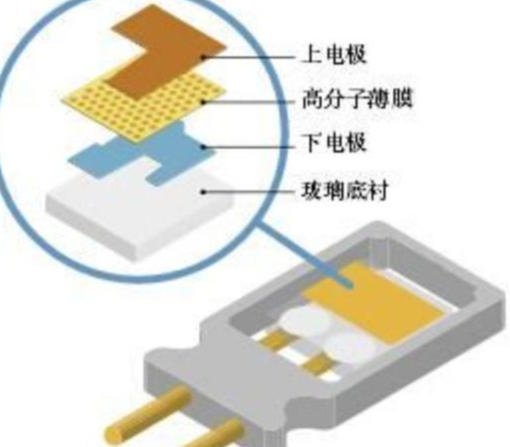
The types of Humidity sensor chips are varied, but in terms of application breadth and technological advancement, the main types are as follows. Currently, the mainstream choices are capacitive and resistive sensor chips based on MEMS technology, with integrated smart sensors representing the ongoing trend.
Type
Core Principle
Advantages
Disadvantages
Typical Applications
Capacitive (Mainstream)
Hygroscopic material (e.g., polyimide) changes dielectric constant with Humidity, causing capacitance change.
High accuracy (±1–3% RH), fast response (<8 s), low power, wide range (0–100% RH).
Susceptible to chemical gas contamination and electromagnetic interference.
Consumer electronics (smartphones, ACs), weather stations, industrial process control.
Resistive (Traditional)
Hygroscopic material (e.g., lithium chloride) decreases electrical resistance as humidity increases.
Simple structure, low cost, easy to manufacture.
Lower accuracy (±3–5% RH), poor long-term stability, easily contaminated.
Agricultural greenhouses, soil moisture monitoring, low-cost hygrometers.
Thermal Conductivity (Specialized)
Measures absolute humidity based on difference in thermal conductivity between water vapor and air; changes power of thermistor.
High temperature resistance, contamination resistant, suitable for harsh environments.
Lower accuracy (±2–5% RH), slow response (>30 s).
Industrial process control, flue gas humidity monitoring, high-temperature drying tunnels.
Optical (High-end)
Measures changes in optical signals (wavelength, phase) caused by humidity variation.
Highest accuracy (up to ±0.5–1% RH), EMI resistant.
Very high cost, large size, complex system.
High-precision labs, chilled‑mirror dew point hygrometers used as calibration standards.
Contact: James
Phone: +86-15684187478
Tel: +86-15684187478
Email: james.shi@teleclear.cn
Add: Room 1116, Yeda Zhigu Building A, No. 300 Changjiang Road, Yantai ETDZ, Shandong, China